
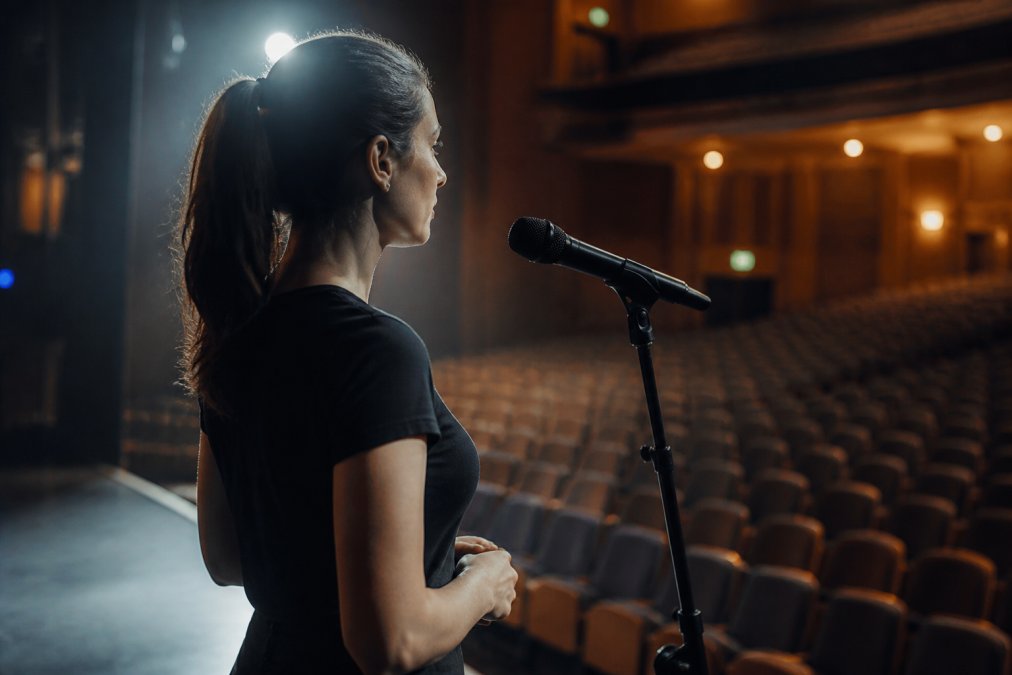
Why Your Body Reacts Before You Sing a Note
Your racing heart and sweaty hands before a solo are not weakness, they are your nervous system doing what it evolved to do. Stage fright is a stress response: your brain reads a performance as a threat, releasing adrenaline and triggering fight or flight.
Stage fright is a physical response, not a character flaw. You cannot think your way out of it. You have to work with your body.
Breathing Techniques for Singers That Calm the Nervous System
Breathing techniques for singers are the fastest way to calm a racing nervous system. Slow, deep breaths signal safety to your brain and lower your heart rate. Most singers breathe too shallowly when nervous, which cuts air supply and makes the voice wobble. Two methods fix this.
Diaphragmatic Breathing: The Foundation
Diaphragmatic breathing means breathing from your belly, not your chest. Place one hand on your stomach and one on your chest. Breathe so only the lower hand moves.
- Sit or stand tall with relaxed shoulders
- Inhale through your nose for four counts
- Feel your belly expand, not your chest
- Exhale slowly through pursed lips
- Repeat for five minutes
The 4-7-8 Breath for Pre-Performance Calm
The 4-7-8 breath slows your heart rate fast: inhale for four counts, hold for seven, exhale for eight. Do four rounds backstage, many performers find it works within two minutes.
How to Stop Shaking While Singing
To stop shaking while singing, ground your body and release muscle tension before it takes over. Shaky hands and a trembling voice come from adrenaline, not lack of talent, and the fix is physical, not mental.
Grounding Techniques for Shaky Hands and Voice
Grounding techniques pull your attention into your body and out of your head. Try these before and during a performance.
- Press both feet firmly into the floor
- Hold your microphone with both hands early on
- Grip the mic stand lightly between verses
- Roll your shoulders back and down
- Take one slow breath before each new song
Shake out your hands and arms for ten seconds right before you walk out. It sounds silly, but it releases built-up tension that shows up as a wobble in your first line.
Using a Teleprompter for Stage Presence and Eye Contact
Using a teleprompter for stage presence lets you keep your eyes up and your lyrics in view at once. When you are not looking down at a music stand, you can actually connect with your audience.

Why Hiding Lyrics Builds Confidence
When lyrics are hidden from the audience, you stop worrying about mistakes being visible. That single change reduces on-stage anxiety for a lot of performers.
Eye contact is stage presence. A teleprompter that hides your lyrics from the audience lets you look up without losing your place.
Building a Pre-Performance Routine That Works
A pre-performance routine is a fixed sequence of actions you repeat before every show. It tells your brain that performance time is coming, so the nerves arrive on schedule instead of ambushing you.
The Fixed Core: A 13-Minute Sequence
This core stays the same no matter where you sing. Run it in order, and do not skip steps because you feel calm, the routine is what keeps you calm.
| Step | Action | Time | Why It Helps |
|---|---|---|---|
| 1 | Lip trills and humming | 5 min | Warms vocal cords gently without strain |
| 2 | Diaphragmatic breathing | 3 min | Signals safety to the nervous system |
| 3 | Mental rehearsal of the first 30 seconds | 2 min | Removes the biggest unknown, your entrance |
| 4 | Positive visualization | 2 min | Builds confidence before you start |
| 5 | Grounding and shake-out | 1 min | Releases muscle tension that shows up as a wobble |
The Adjustment Layer: Match the Routine to the Room
Once the core is done, spend two to three minutes on the layer that fits your performance type.
- Solo audition: Arrive early enough to walk the room alone. Stand where you will stand, say your first line out loud once, then leave the space. Claiming the room before anyone is watching reduces the threat signal your brain reads when you return.
- Ensemble or worship set: Do a silent count-in with the band or track. Confirm your monitor or in-ear mix before the downbeat. Most on-stage panic in group settings comes from not being able to hear yourself, not from the crowd.
- Studio recording: Record one throwaway take on purpose. Singing a take you have already decided not to keep lowers the stakes and lets your body settle into the booth. Engineers commonly see singers loosen up by the second or third pass.
Timing: When to Start the Routine
Start the core about 20 to 30 minutes before you go on. Finish the adjustment layer 5 to 10 minutes out, then stop working. Singers who keep rehearsing until the last second arrive at the mic already depleted.
Write your routine down and keep it in your gig bag. A routine you have to remember on the spot is not a routine, it is another thing to be nervous about.
A routine works because it is boring and repeatable. The fixed core calms your body; the adjustment layer prepares you for the specific room you are about to walk into.
Managing Adrenaline and Post-Performance Recovery
Most articles tell you to breathe and think positive, skipping what actually drives stage fright: the adrenaline itself. Understanding what adrenaline does, and how to bring your body back down on both sides of a performance, is the difference between managing nerves and just enduring them.
What Adrenaline Actually Does to a Singer
When your brain reads a performance as a threat, it triggers fight-or-flight, releasing adrenaline (epinephrine) and cortisol into the bloodstream. That surge does several things that directly affect your voice:
- Heart rate and breathing speed up to move oxygen to muscles, which is why your first line can feel breathless.
- Blood is redirected toward large muscles and away from your hands and mouth, which is why fingers and lips can feel cold or shaky.
- Muscles tense in the neck, jaw, and shoulders, which is why pitch and tone can wobble even when you know the song cold.
- Attention narrows to the perceived threat, which is why you can blank on lyrics you have sung a hundred times.
Downregulating the Rush Before You Sing
You cannot think your way out of a chemical response, but you can physically signal your nervous system that the threat is not real. The most reliable lever is your exhale. A long, slow exhale activates the parasympathetic nervous system, the branch that tells your body to stand down.
- Inhale through your nose for a count of four.
- Exhale through pursed lips for a count of six to eight, longer than the inhale.
- Repeat for two to three minutes.
The Post-Performance Come-Down
The adrenaline rush does not end when the last note lands. For many singers, the harder part comes after, a crash of fatigue, self-criticism, or flat emptiness once the applause stops. Some call this a vulnerability hangover: the emotional dip that follows putting yourself on display. It is normal and predictable, so plan for it the way you plan for pre-show nerves.
- Sit down and breathe slowly for a few minutes, do not rush to pack up or socialize.
- Drink water at room temperature.
- Stretch your neck, jaw, and shoulders.
- Avoid loud talking for a while.
- Write down one thing that worked and one thing you want to change.
Recovery Over a Long Season
Post-performance recovery matters most for singers who perform several times a week. Skipping it leads to vocal fatigue and mounting anxiety, because your body never gets the signal that the threat is over. Build a short recovery ritual and treat it as part of the gig, not an optional extra, over a season of shows, the singers who recover well still sound strong on the last date.
Do not head straight to a loud after-party and shout over the noise. That strains vocal cords that are already tired and can leave you hoarse for the next show. Give yourself at least 20 to 30 minutes of quiet first.
Adrenaline is not the enemy, an unmanaged adrenaline spike is. Downregulate before you sing with long exhales, and give yourself a real come-down after, especially if you perform multiple times a week.
What to Eat, Drink, and Avoid on Show Day
What you eat and drink on show day affects your voice and your nerves more than most singers realize. Hydration and steady energy keep your vocal cords working and your hands steady.
Follow these simple rules:
- Drink water throughout the day, not just before you sing
- Eat a light meal one to two hours before you go on
- Choose easy foods like bananas, oatmeal, or toast
- Limit caffeine, which can add to the jitters
- Avoid alcohol, which dries out your vocal cords
- Skip heavy, greasy meals right before a set
Stage fright will show up whether you are a first-timer or a seasoned worship leader. The difference is whether you have a system to handle it.
Frequently Asked Questions
What are the physical symptoms of stage fright while singing?
Common physical symptoms include shaking hands, a trembling voice, rapid heartbeat, sweating, dry mouth, and muscle tension in the neck and shoulders. These are triggered by the fight or flight response, which releases adrenaline into your system. The good news is that breathing techniques for singers, such as diaphragmatic breathing, can directly calm this response. Pairing breathwork with a consistent pre-performance routine gives your body a predictable signal that it is safe to perform.
How can I stop shaking when I sing on stage?
Shaking comes from adrenaline and muscle tension, so the goal is to regulate both. Start with slow diaphragmatic breaths before you walk on stage. Grip the microphone firmly but not tightly, and plant your feet shoulder-width apart to ground yourself. Shifting focus away from self-judgment and toward your lyrics or your audience also helps. Many performers find that having clear mental cues, whether from rehearsal or a discreet prompter, reduces the mental load that feeds the shakes.
Does stage fright ever go away for singers?
For most performers, stage fright does not disappear entirely, but it becomes manageable with practice and the right tools. Professional singers often describe nerves as energy they redirect into their performance rather than eliminate. Building a reliable pre-performance routine, mastering your repertoire, and using grounding techniques can turn anxiety from a blocker into fuel. The goal is not zero nerves; it is performing well even when they show up.
How does using a BLACK BOX Prompter help with stage presence?
BLACK BOX Prompter keeps lyrics, chords, or scripts visible to you but hidden from the audience.
That means you can maintain eye contact and engage naturally instead of glancing down at a tablet or music stand. Reduced reliance on memorization lowers mental load, which in turn reduces on-stage anxiety. For worship leaders and gigging musicians alike, that combination of preparation and discreet support leads to stronger delivery and a more connected performance.