
The Real Difference Between Professional and Consumer Stage Gear
Ask ten cover band musicians (or worship leaders) whether professional stage gear is worth it and you’ll get ten different answers, usually delivered with strong opinions and very little evidence. Here’s the honest version: pro gear isn’t magic, and it won’t fix a weak performance. What it does is remove variables you can’t afford to worry about when the lights come up.
Professional stage gear is equipment built to survive repeated touring and deliver consistent results under pressure, while consumer gear is designed for occasional home use at a lower cost. The gap shows up in build quality, component longevity, and reliability, not in some intangible “pro sound.”
At BLACK BOX Prompter, we talk to working musicians and worship leaders every week, and the pattern is consistent. The players who upgrade wisely aren’t chasing tone. They’re buying predictability.
Pro gear earns its price through reliability and repeatability, not through sounding dramatically better in a bedroom. Judge it by what it does on night 200, not night one.
The Benefits of Using a Teleprompter for Musicians
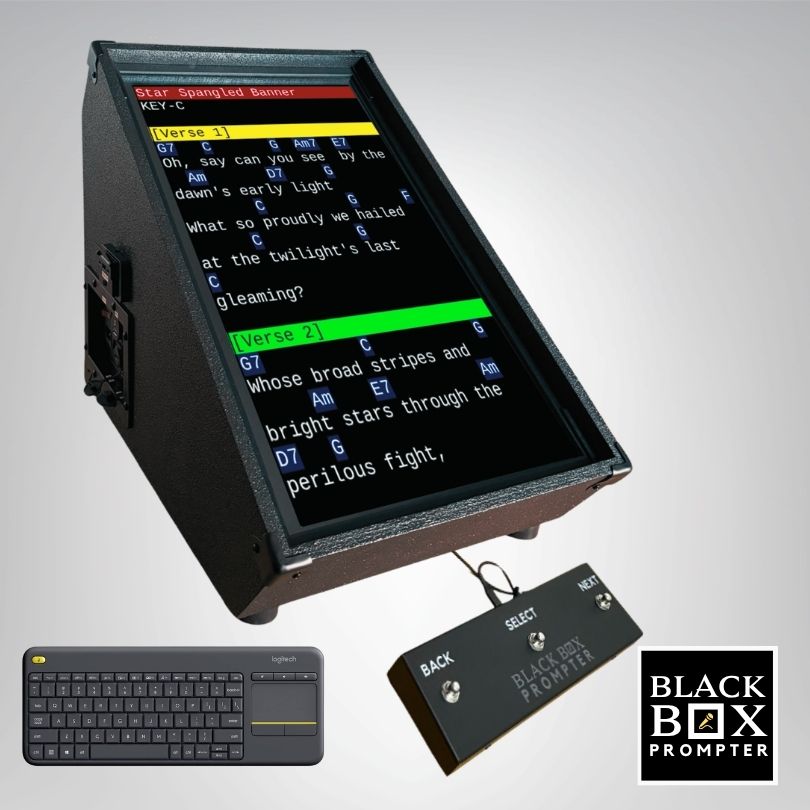
A teleprompter for musicians is a discreet display that shows lyrics, chords, or set notes at floor level, hidden from the audience, so performers keep their eyes up instead of down at a tablet. The benefits of using a teleprompter for musicians come down to three things: consistent delivery, fewer lyrical stumbles, and a stage presence that actually connects.
Think about what happens when a song slips your mind mid-verse. You glance down. Then you stay down, because the next line is right there and you don’t trust yourself yet. That glance becomes a habit, and the audience feels the disconnect even if they can’t name it.
A lyrics prompter fixes the root cause. Your cues sit where only you can see them, and your face stays where the room can see it.
Reducing On-Stage Anxiety for Performers with the Right Tools
Reducing on-stage anxiety for performers rarely happens through willpower alone. It happens when you remove the specific unknowns that trigger it. Memory gaps, forgotten set transitions, and last-minute key changes are the usual culprits, and each one has a tool-based fix.
The psychology here is straightforward. Anxiety feeds on uncertainty. When you know your lyrics are one glance away and your set list is already loaded, your brain stops allocating resources to panic and starts allocating them to performance.
That’s the part most gear guides skip. They treat equipment as a sound decision when it’s often a confidence decision.
Load your set list before soundcheck, not after. The ten minutes before doors open are the worst possible time to be importing files and second-guessing your order.
Essential Live Performance Gear: What Actually Earns Its Place
Essential live performance gear is the short list of items that solve a real problem on stage, not the long list of items that look impressive in a catalog. Most working musicians need far less than they think. The test isn’t “does this make me sound better”, it’s “does this remove a variable I can’t control?”
Here’s the honest short list, with the mechanism behind each pick:
24″ Wedge Teleprompter for Musicians →
- Reliable instrument (and backup) cables. Cables fail more often than anything else in your rig because they take the most physical abuse, repeated coiling, strain at the connector, and foot traffic. A spare instrument cable and a spare mic cable cost little and eliminate the single most common mid-set failure.
- In-ear monitors or a personal monitoring solution. Hearing yourself clearly changes how you sing and play because you stop pushing volume to compete with the room. When you can hear your own pitch and dynamics, you naturally sing softer and more in tune.
- A tuner you trust. Not a phone app in a noisy room. A clip-on or pedal tuner reads the vibration of your instrument directly, while a phone mic picks up the whole band and gives you a moving target.
- A lyrics prompter or monitor. This is the one most players delay and later wish they hadn’t. The mechanism is simple: when your cues are visible without a head-down glance, your eyes stay on the room, and the audience stays connected to you.
- A power supply with surge protection. Venue power is unpredictable. A surge protector is cheap insurance against a voltage spike that can fry an amp or a pedalboard in a single moment.
- A small toolkit and spare strings. Basic, boring, essential. A broken string mid-set without a backup is a set-ending event.
Notice what’s missing. You don’t need the most expensive option in every category. You need the one that won’t fail when it matters.
Here’s the trade-off most gear guides skip: every item you add to your rig adds setup time, weight, and a new failure point. The goal isn’t a bigger rig, it’s a rig where every piece earns its place by solving a specific problem. If you can’t name the problem a piece of gear solves, it’s probably not essential.
Essential gear isn’t about having the most options, it’s about having the fewest failure points. Every piece should solve a problem you’ve actually experienced, not one you imagine you might.
Total Cost of Ownership: What Professional Stage Gear Really Costs
Total cost of ownership is the full expense of a piece of gear across its working life, including purchase price, maintenance, replacements, and the cost of the failures it prevents. That last category is the one nobody calculates, and it’s usually the largest.
| Cost Category | Consumer Gear | Professional Gear |
|---|---|---|
| Upfront price | Lower | Higher |
| Replacement frequency | Frequent | Rare |
| Mid-performance failure risk | Higher | Lower |
| Resale value | Minimal | Meaningful |
| Setup time per gig | Often longer | Often shorter |
Rental vs. Buy: A Decision Matrix for Gigging Musicians
Renting makes sense when your usage is occasional or your needs are still changing. Buying makes sense when the gear becomes part of your regular workflow. Here’s how to decide without overthinking it.
Use this framework:
- If you gig fewer than six times a year, rent or borrow from a friend. You’re paying for flexibility.
- If you gig monthly and the gear is central to your performance, buy. Rental fees compound fast.
- If the gear is still an experiment, rent first. Test it in a real room before committing.
- If the gear is a lyrics prompter or monitor, buying usually wins. It becomes part of every set, and the learning curve is worth owning outright.
- If the gear is a large backline item you use twice a year, rent. Storage and transport are their own costs.
Common Mistakes When Buying Professional Stage Gear
Other frequent errors:
- Chasing specs over workflow. A higher number that doesn’t fit how you actually perform is wasted money. A monitor with more inputs than you’ll ever use is just more to configure.
- Ignoring setup time. Gear that takes twenty minutes to assemble won’t get used at a short set. The best gear is the gear you’ll actually set up every time.
- Skipping compatibility checks. Confirm your signal chain, connectivity standards, and power requirements before you buy. A piece of gear that doesn’t play well with what you already own becomes a problem, not a solution.
- Assuming more expensive means more reliable. It usually does, but not automatically. Read the warranty and the support terms. A high price tag doesn’t guarantee a company will answer your email when something breaks.
- Forgetting the subscription question. Some performance tools require ongoing monthly payments. That changes your total cost of ownership significantly, and it means you never actually own the tool.
Watch for subscription-based performance tools. A low upfront price with a monthly fee can cost more over three years than a one-time purchase, and you lose access the moment you stop paying. Always ask: does this tool work if I stop paying?
A lyrics monitor is a good example of a category where the buying decision is simple if you plan to use it regularly.
BLACK BOX Prompter is a teleprompter made for musicians that is 100% self-contained allows you to import standard file document types (e.g. .txt, .docx, .pdf), and carries no monthly subscription which removes an entire category of recurring cost, and it doesn’t require a technical skill set to integrate.
You load your set, you perform, you’re done. If you want to see how that looks in practice, the BLACK BOX Prompter walks through transferring your songs, and How to Create or Edit Set Lists on the Prompter shows how quickly a set comes together.
Worship leaders and gigging musicians who perform weekly and want a fixed, predictable cost instead of an ongoing subscription.
Frequently Asked Questions
Does professional gear actually reduce performance anxiety?
Yes, for many performers. When your gear is reliable and your lyrics or chords are visible without the audience noticing, your brain stops juggling logistics and can focus on the performance. A teleprompter for musicians, for example, keeps lyrics and chords hidden from the crowd while giving you clear mental cues. That reduction in divided attention is one of the biggest drivers of lower on-stage anxiety.
Is it better to rent or buy professional stage gear?
It depends on how often you perform. Renting makes sense for one-off events or trying a piece of gear before committing. If you gig monthly or lead worship weekly, buying usually wins because rental fees add up fast and you never build equity. BLACK BOX Prompter offers subscription-free solutions, ensuring a predictable cost.
What equipment is essential for a professional live performance?
At minimum: a reliable instrument or vocal rig, a monitoring system you trust, sturdy cables and stands, and a way to keep lyrics, chords, or scripts accessible without distracting the audience. Many worship leaders and gigging musicians add a lyrics prompter because it replaces tablets and music stands with something the crowd never sees. Everything else depends on your genre and venue.
How do you know if a piece of stage gear is worth the cost?
Run the numbers over three years. Add the purchase price, any subscriptions, maintenance, and the resale value you would lose. Then compare that to what the gear saves you in setup time, mistakes, or rental fees. Gear that removes a recurring problem, like fumbling with an iPad mid-song, usually pays for itself long before it wears out.